PAUL WERNER, CONTEMPORARY DUTCH ARTIST PAINTER, Amsterdam - The Netherlands
watercolors and litho prints; for sale & worldwide shipping
for a short impression of the recent watercolors and litho graphic art by contemporary painter artist Paul Werner, some pictures of his recent painting art.
click for more landscape paintings on the website of artist Paul Werner
| |
GOOGLE+1 |
|
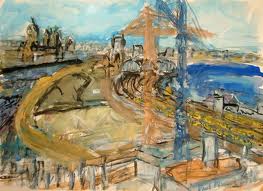
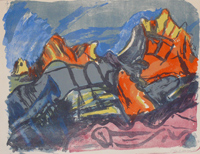
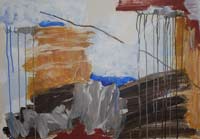
Constructions in Amsterdam city - watercolor, 2006 |
landscape on paper, 1997 |
|
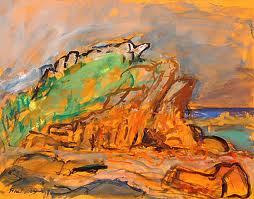
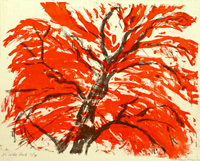
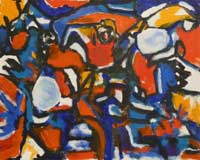
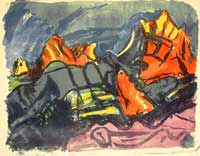
Burning willows, 2003 |
watercolor on paper, 1997 |
|
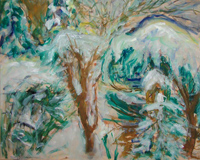
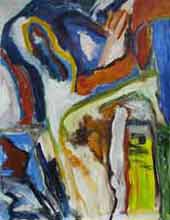
My garden in snow - watercolor, 2005 |
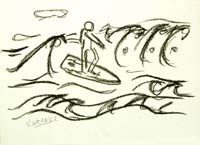
lithography art print, 1997 |
|
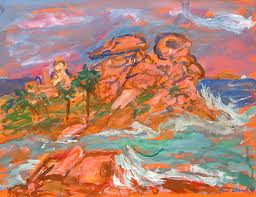
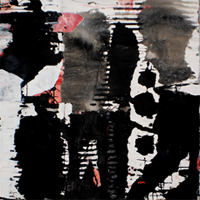
Willows in an Amsterdam parc, 2005 |
lithography print 2009, 2009 |
click for more landscape paintings on the website of artist Paul Werner
some remarks by the artist Paul Werner, Amsterdam - The Netherlands
My favourite technique I prefer to use is gouache on paper. during fifty years I painted a lot of landscapes plein air, mostly in an expressionistic and colorful manner. My use of colors is not completely natural, because the colors appear because of my experience and my interpretation of the motif. I am searching for rhytmical compositions, and so I reach almost abstract compositions. But I keep the landscape as my living motif, becaue I must be able to feel, touch, hear and see the landscape plein air!
My art can be divided into three parts
1. landscapes, especially the coasts and cliffs of Britanny and Normandy (France), the flat country of The Netherlands, the city Amsterdam with its old ports and harbours. I made also a lot of paintings of gardes and trees, because I love them and a lot of them disappear in the cityen.
2. grafic art: lithography, in color as well in black white. I made them seperate as well as in collections by grafic artbooks with a common theme where text is combined with lithography. I made grafic art-books on Vincent van Gogh, as a hommage to Lorca, on the old story Guigemar (een Britan mythe written by Marie de France) and a grafic book on trees.
3. lithography with a political inspiration, as for instance the American politics on Vietnam and Iraq.
Paul Werner
Paul Werner - Dutch contemporary landscape painter and graphic artist, litho
representational painting
Despite all his visual freedom Paul Werner as a painter is a very loyal and faithful artist in representing the motives he chose to represent in his art in a convincing and still connected expression. It is because he feels closely connected to the motives he loves, that he paints. He keeps observing and watching, discovering and exploiting the typical forms of the rocks, the trees, the shore or the landscapes he sees before him. So, Werner is definitely a figurative painter, but he frequently meets abstract dimensions, because of the borders he is exploring in his figurative representation. This is his necessary consequence of using all the freedom he can mobilize while portraying the landscape before him, his own garden or just a lonely tree reflecting its branches in the lake. He never departs from his chosen motive for the attraction of completely abstract painting.
as a young artist
How to find your own style as young artist in the midst of Amsterdam’s experimenting artistic world during the 1960’s? It was quite a task, especially when your own artistic style appears to be totally un-modern, and just a solid expressionist and figurative style. This was the problem faced by Paul Werner around 1950. He moved then to Amsterdam to find a job to earn a living and also pay for his own education in paining. Art had always been part of his childhood, his father was an oil painter in his free time, and he had an uncle who collected contemporary paintings from artists around him, in exchange for food or drink. He also had another uncle who wandered round Holland and Belgium drawing and sketching.
landscape painting
As early as 1957 Paul Werner became strongly fascinated by the wild landscapes and the rocky coast of Brittany in Franc. He would return to his beloved seascapes many times, and frequently painted his gouaches on paper on the spot, on the wild coasts with the wind, tangy smell and sea around him. The weird rocks in the water with all their figurative suggestions would be portrayed by Werner in a style of painting growing more and more free over the next 40 years. One characteristic quote of the artist:
‘My use of colors is not completely natural, because the colors appear because of my experience and my interpretation of the motif. I am searching for rhytmical compositions, and so I reach almost abstract compositions. But I keep the landscape as my living motif…’.
More and more Paul Werner succeeded in painting the solid, heavy rocks of the Normandy wild coast as spatial open forms, which you can enter as a spectator with your eyes. and he loaded them with his imagination; so their appearance in his paintings look like huge animals or other creatures.
his influence
It was, and still is this characteristic of painting by Paul Werner – very impulsive and full of free associations and little nervous movements on the paper – which created his personal visual freedom. It followed from the tradition of expressionism (Van Gogh, Soutine), but that kind of expressionism mixed with energy and with images, so transparent and open, that Paul Werner inspired some younger abstract painters around him, such as Fons Heijnsbroek.
Jean Homacher
some reflections on the art of Paul Werner
Sometimes it is completely abstract-expressionism we are looking at, in the paintings and lithos of Paul Werner. That is not strange at all, because one painter he loves very much is Willem de Kooning; Paul werner do understand his brush-gestures and his color-tones very well. However there exists also a big gap between the two; Paul Werner realizes himself in a more traditional way and closely bounded connected with its subject; he never allows himself to make much distance from the subject he choose. That’s why in his works the subject almost never disappears into atmosphere or in the free gestures, or in the colors itself. For Paul werner there must be some similarity and possibilities to make recognition somehow or somewhere. The world must show its daily face in his paintings or lithography. This is the boundary which kept and still keep him in the tradition of Dutch and Belgium expressionism. Also Soutine and Van gogh are very much present in his work. These are the two great ‘loves’ of Paul Werner. (it is not by accident that also De Kooning was very strongly influenced and inspired by Soutine and his influence always resonates in de Koonins paintings and sculptures. So it does with Paul Werner!)
I am from a younger generation Dutch artists than Paul Werner is; nevertheless I can realize very well what it meant to paint just nature and figuration in a period in Amsterdam where every young artist painted emotional neo-Cobra or emotional abstractions, or a clean formel-abstract art. Paul Werners subjects were - despite all kind of modernism around him - the impressive Dutch and French landscapes full of energy and movement, but also the political protest from those days (1960-1975). Both influences and powerful sources to Paul asked the full attention of his emotional inner self. He stayed faitfull to these elements of the world which fascinated him and which he loved very much: skies, mountains, the coast with a wild sea, the wild wood with his huge trees or the emptyness of a wide vue.
Also the peace-movement and the protest against the Vietnamwar attracted him strongly as a struggle against unjustice, he hated. He kept his emotions alive - however that was a hard job - and it was his strength to be able to use them very sensitively. They didn’t start to dictate him or his paintings; also on the opposite, he didn’t kill his emotions but gave them space to live and to breath. So he could use them as the source for his act of painting. And in the same time they accepted the boundaries of portraying the subjects he wanted to. That’s why I consider him as an Dutch modern expressionistic and naturalistic painter.
Fons Heijnsbroek
YOU ENJOY THE WEBSITE??