BEN VOLLERS, CONTEMPORARY DUTCH ARTIST PAINTER, Amsterdam - The Netherlands
paintings and ceramics; for sale & worldwide shipping
for a short impression of the recent painting art and ceramics by contemporary painter artist Ben Vollers, some pictures of his recent painting art.
click for more art images on the website of artist Ben Vollers
|
|
GOOGLE+1 |
|
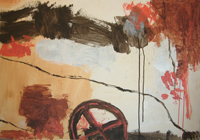
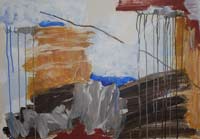
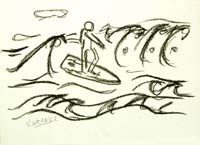
painting on paper, 2005 |
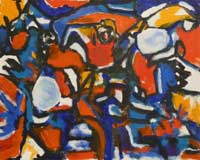
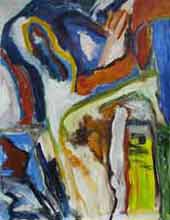
painting on canvas, 2007 |
|
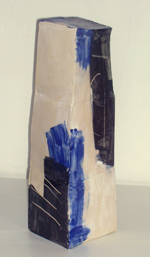
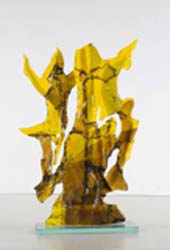
ceramic tower, 2005 |
painting on paper, 2011 |
|
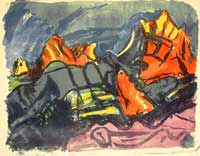
painting on paper, 2009 |
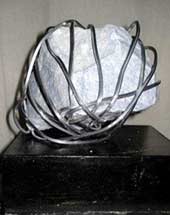
ceramic towers, 2006 |
|
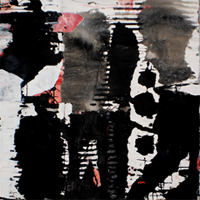
painting on paper, 2006 |
painting on paper, 2010, |
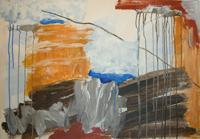
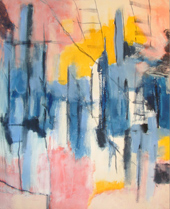
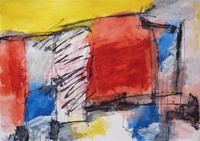
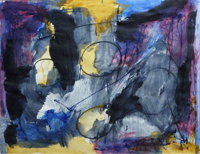
click for more art images on the website of artist Ben Vollers
Dutch painter artist Ben Vollers, Amsterdam - The Netherlands
Ben Vollers (born in 1947) is a Dutch artist who has been creating abstract paintings on both canvas and paper since 1988.
Classic antiquity plays an important role in his work as does European history. The titles of his work very often refer to this. He sees his work as ‘visual footprints of the past’ as it lives and relives in his imagination. His art is in no way an illustration of history or historic stories but rather he moves the past into a present day form of abstract art.
Ben Vollers paints with strong full brush strokes, creating robust planes of colour. The drawing in his paintings takes place in thin intuitive lines that move over and between these planes of colour as a necessary light and rhythmic opposition. There is a great deal of atmosphere in his work which is evoked by the coloured planes and their resonance.
Ben Vollers paints spontaneously and without any preconceived idea. His abstract paintings develop on the spot, with free association of colour, line and form. His physical impulse is particularly apparent in his ‘graffiti type’ lines that move carelessly through the large forms, sometimes they form the start of the painting and sometimes they are the finishing touch.
There is a clear Dutch influence in Ben Vollers’ art, an atmospheric content which is definitely from the Dutch skies and the water in and around Amsterdam. This atmosphere softens the large, robust planes of colour in his work and gives a depth and added layers to the painting that Ben Vollers demands of himself.
Jean Homacher
Ben Vollers - Dutch contemporary painter artist and the light in his abstract paintings
In the course of recent years Ben Vollers is implicating more and more the light and the atmosphere in his painting. About four years ago the work of the Venetian Rococo painter Tiepolo became of great significance for him. Vollers thin cloudy apply of the paint, put down with a loose brush, has gut much relationship with the clear colours of fresco which Tiepolo so lightly conjured on the walls of so many Spanish churches. This meeting with an old painter helped Ben Vollers to realize in his pallet of colours a stronger clearness, a dose of carelessness and a surly charm. However, Dutch origin cannot be pushed away so easily. Good art always has his regional part too: she is not afraid to show her roots, her typical origin. In the paintings of Ben Vollers we can smell the Dutch moist airs and the humid soil in which the houses stand there with their feet. We recall easily to the famous painter Jacob Ruysdael who painted in Holland during the 17th century subjects like the Jewish cemetery, a castle in ruin near the dunes around Haarlem or Swedish waterfalls. In the way of painting of Ben Vollers we find back the traces of the painting tradition of Dutch landscape. It was in this tradition the very painters choose in concord for the atmosphere of the landscape. They explored all possibilities of brown, grey and the many earth-colours to reconstruct that mysterious depth in their canvases, they could see in the nebulous airs of spacious river-landscapes almost every day.
We will not find spacious distances in the works of Ben Vollers, because he has lifted up the landscape. Upright it stands under our very nose. We don’t look in the depth at his work but things and forms which populate his canvases lively appear just in front of our very eyes. Between these many things and forms there is room left of which we can experience the mist and the damp. These things do not stand hard and isolated for themselves because they are assimilated in a totality of atmosphere. On one spot of the canvas we can see a fragment of a landscape, a fence, a way. But next to it our eyes strike against a thing of daily use, a wheel, a pot, a book. Everything swam around in the paintings of Ben Vollers, painted in a great variation of different colour tones. His paintings presented on Dutch Abstract show a busy-populated world of things worked on by imagination, bur undeniable coming from daily life we all do live in. All objects and parts of landscape are connected in the very fog of atmosphere, so characteristic for the Dutch low country land and for the artist himself.
Jean Homacher
artist quotes by Ben Vollers
1993:
To me composition means a sort of balance. I shuffle and move a lot, I move towards a balance as it were. Then I feel I have created something aesthetically beautiful. Because that’s what it has to be for me, even if someone else just sees pigeon shit! Even then there is balance and harmony.
1993:
The tonality in my work has a lot to do with depth. Actually I want flatness in my paintings not depth. However, intuitively I still use the tones to create a depth – I can’t not do it! I think in the end I want this paradox in my work. Depth and flatness. As long as the paradox is not apparent there is no painting and I have to keep at it!
1993:
The plans in my painting are mobile décor pieces. However, they develop from the way the paint or other material is applied.
1993:
Colour influences the way you look into the canvas. Recently I had a good composition, a lot in black but the middle of the black area was too hard. So I changed it to another colour and then another… Then at last the middle area withdrew and became a whole with the rest of the canvas.So, for me, colour is depth.
2004:
In my work I often put a timeless and universal atmosphere into abstract images. These images emerge from a personal world of experiences, amongst other things a fascination for ancient cultures and mediteranean influences. I want to express the fleetingness of human cultures with references to remains of old walls, ruins of Greek temples or empty factories.
2004:
One could call my method of working intuitive – an exchange between emotional exploration and purely pictoral decisions. Because I want to leave the audience free to form their own interpretation of my work I find that naming the work is not a priority.
2005:
I feel closely related to artists of the New York school of the fifties. This is actually a better term than Abstract Expressionism.I know the work of a number of them and their development which really appeals to me; especially the freedom and spontaneity, but also the automatic writing and the ‘gesture’.
I came into contact with their work through the Stedelijk museum and the magazine “Openbaar Kunstbezit” (later Kunstschrift), and even later when I was studying history with history of art as an extra module. When you start painting abstract work you have to stop and think about what, how and why, and that took me to their work.
2005:
I just begin (painting) a couple of coloured lines, an area of colour, another area of colour. Then look and see whether I like it, sometimes for days on end.
2006:
An important theme in my work is the Myth of Oresteira for instance, (with her classic murder of her mother) that takes place in Mycene in the Peloponnesus. Also the reference of these characters to Jung’s archetypes. My work is often mythical and sometimes bloody.(Violent)? This raises associations with bloodbaths such as the head hunters of Papua New Guinea or the Dayaks in Indonesia and ancient sacrifices such as that of Iphigineia before the Trojan war.
2006:
Sometimes there can be a musical influence in my work, from jazz I happen to be listening to. Sometimes the influence is direct, by using my brush in time with the music. Here the gesture is directly determined by the music. Often music determines the emotion from which I work.
2006:
A totally different line in my work is my experience of ‘deja-vu’ (having experienced or seen something before). The deja-vu in my work has to do with second-hand objects from flea markets, such as razors, vacuum cleaners etc. In some of my work I paint these as abstract collections. But old,disused factories with the weathered walls of the empty buildings all evoking their own history can also lead to this experience.
2007:
Personally, the informal artists and their work really appeal to me. I love the material, the marks, the disorder, the coincidental and intuition of it all, the graphic art within.
comment of an owner
Hans Cohen
I have been collecting modern abstract painting since around the mid eighties. Colour and abstraction has, more or less, always been my guide. In the beginning I went for the colourful work of the Cobra artists. Allthough I could never afford to buy an original Karel Appel, I did acquire a couple of works from other Cobra artists. Later on I expanded the modest collection with works of other artists who where painting with an even so colourful palette. Later on my taste of art was shifting towards more and more abstraction. At first, colour and composition were the main focus. Some abstract-figural elements might have been present in those days. But now my focus lies mainly on the complete abstract art.
Through Artolive online I accidently stumbled upon the work of Fons Heijnsbroek….
……Through Fons I met Ben Vollers and Daan Lemaire. They both share the same ideas about abstract art and naturally I became interested in their work too. Ben paints colourful canvasses and works on paper. It is not as abstract as Fons’ work but they are very balanced, colourful and narrative. In 2006 Fons and Ben started literally a painting joint-venture. Together they worked on the same canvas and by doing so they had to give in, let go, anticipate and react on each others brushstrokes. This resulted in a complete new and exciting co-operation with beautiful results. One of those results is hanging on one of my walls at home!
A Dialogue in paint
In 2006 Ben Vollers and Fons Heijnsbroek started to paint together. Same spot, same moment, on the same canvas. What started as a one-stand afternoon performance grew out into a rather unusual, intensive dialogue-in-paint between the two Dutch abstract painters. They knew each other for 15 years already very well, but this was the first time they started to paint together, making one canvass together. In the last two years they painted 30 big paintings together, and they developed a lot of confidence and freedom during their common painting practice.
Ben and Fons paint personally abstract and expressive and like to use their direct visual impulses coming into the painting. This is the basic ground in their cooperation. Beside they love abstract expressionistic art and discussed a lot all the former painters who gave shape to this area of painting. Both artists also share their love for the city of Amsterdam and its modern visual dynamics. And perhaps it is a gift that both love the jazz. Also mutual: they want to incorporate in their art the unknown, the not preconceived, not predictable. There is to find what they mean fort the other during the common painting: in a mutual way they are the unknown for the other. Every moment during the painting the development of the painting is unsure because of ‘the other one’, who is allowed to change the whole painting. So they accept they are dependent on the other and painting itself is the language to communicate: to ask for or to define, to make statements or withdraw them, to argue, to destroy or to affirm. The definite result of the image is for sure when both agree the painting is finished.
In Avallon Burgundy / France) the two artists showed in the Old Roman church a selection of 25 paintings they made together; that was one part of their exposition. The other part was that they painted on the same spot. There they produced a collection of new paintings in a soort of old-roman ‘public church studio’ (visitors could watch them, painting), with as ‘motif’ the river Le Cousin, and its borders. They felt themselves in a broader tradition, as Sam Francis and Joan Mitchell who were former American abstract-expressionist painters, but nevertheless very fascinated by the Water lilies paintings of Monet, so they came to France to search them alive. A year later these paintings wre exhibit in an old church in Amsterdam city
Ben and Fons are Dutch painters and very familiar with the Dutch humid atmosphere and natural light. The river Le Cousin gave them a double landscape because its water reflects the borders and the overhanging trees. It was a challenge for them to catch the atmosphere around Le Cousin and all the reflecting images.
YOU ENJOY THE WEBSITE??