DAAN LEMAIRE, CONTEMPORARY GLASS ARTIST / PAINTER, Amsterdam - The Netherlands
glass fusion sculpture + watercolors; for sale & worldwide shipping
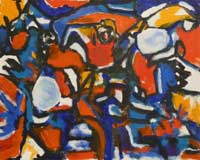
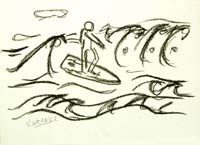
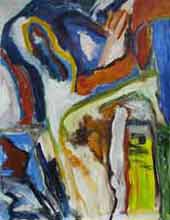
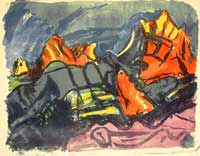
for a short impression of the recent glass fusion art by contemporary glass artist & painter Daan Lemaire, some pictures of his recent glass and painting art.
click for more art-images on the website of glass artist Daan Lemaire
|
|
GOOGLE+1 |
|
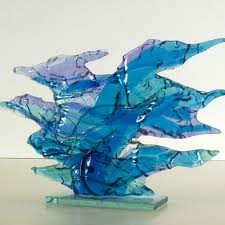
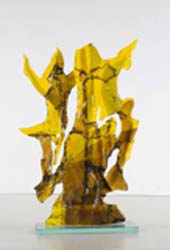
glass fusion art, 2009 |
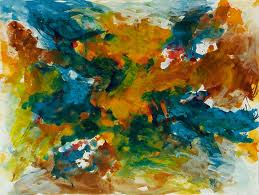
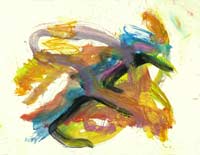
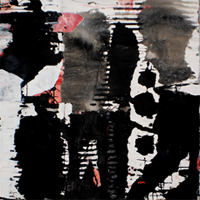
watercolor on paper, 2007 |
|
watercolor on paper |
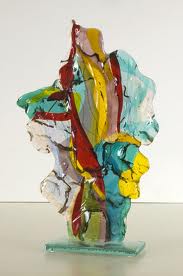
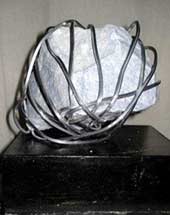
glass fusion sculpture |
|
glass fusion sculpture in blue |
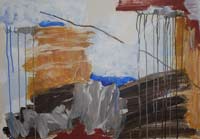
watercolor on paper |
|
glass fusion sculpture art |
watercolor on paper |
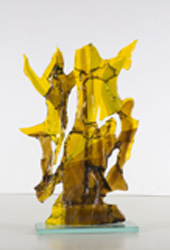
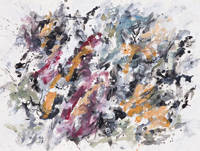
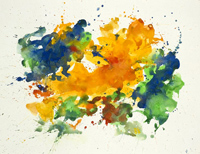
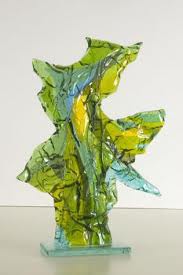
click for more art-images on the website of artist Daan Lemaire
Daan Lemaire - Dutch contemporary glass artist and painter, Amsterdam - The Netherlands
The unexpected
Daan Lemaire, born in 1942, has become a painter/artist who tries to catch the unexpected in his own work. He once said he worked very hard to keep the definite result of his painting process open and formless as long as possible. Painting as an ongoing, never-ending process.
his start
After a few years at the art academy Lemaire moved to Amsterdam in 1963 and started oil-painting on canvas in a surrealistic style with soft colors. It was around 1980 that Mark Rothko’s art made a strong impression on him, and this stimulated the start of his own abstract painting, still with very soft colors. It is the color white he preferred most during these years. Besides that, he was a very patient painter who gave the painting itself a lot of time to grow.
Watercolor – gouache
After a few years his color started to show more strength, especially in his gouaches on paper, which Lemaire started to paint as well as his canvas paintings. These gouaches gave him a free area in which to make his own adventures and discoveries, but they quickly became independent artworks in their own right. Gouache paint can be used in a very direct and transparent way, and Lemaire exploited both aspects. Where his abstract oil paintings were more gentle and soft, his gouaches gave a stronger expression, in brush stroke as well as in color.
Recent years
Since 2005 he no longer paints in oils but only in gouaches. This started after a visit to a show of Sam Francis’s abstract art in Amsterdam. This offered him a new and more dynamic approach for his own painting. Also, looking at Claude Monet’s later paintings, Lemaire discovered new and unexpected perspectives. From there, an intensive exploration in gouache painting started, in which all kinds of possibilities in painting were explored. In colour, in vanishing or pronounced forms, in atmosphere, depth and especially in all sorts of different ways of putting paint on the paper. In this way the ‘line’ started to disappear from his new art. No lines, so no boundaries were accepted any more. The created image should just give a visual moment without any boundary or limitation. That is why his recent paintings exhibit such a huge freedom, but still in his typical delicate and atmospheric sense.
Subtle painting
Lemaire cannot deny his own personal history as a subtle painter, growing up in the Dutch tradition. He doesn’t want to, because he is aware of his connections and roots with the former abstract painters. This is the ground where he started his search for growing expression in his own art, with unexpected images and till now, unknown perspectives. And, always there is his typical gentle atmosphere in his paintings, and that delicate resonance between the colors.
Jean Homacher
Glass fusion - glass fusing
It is from 2004 that I work intensively with the glass fusing technique which gives me a lot of freedom in mixing the colours of the glass by melting it. So I can really ‘paint’ with and inside the glass.
I make glass sculptures in an own design, but also I did make some window-panes or ceiling lights when people asked for it; for the house or the office.
With glass fusing different coloured glass layers are melted together by heating and melting them in the oven; this is the process of the fusion of the glass. After some hours the glass becomes cold and all the seperate glass layers are changed into an one-piece-of-glass. The colours of the glass layers are now mixed in many different ways during the fusion process.
Originally I’am a painter, so the glass fusing technique gives me just what I need: I can paint with coloured glass! Besides this technique gives me many possibilities to create lines in the glass material, so it makes me a drawer in glass too!
I enjoy it to change the flat glass layers into a spatial sculpture. I repeat the melting process several timesand it is during the last fusion in the oven that I use a background with relief, so the melted glass will take over this shape I designed beforehand. So a spatial glass sculpture comes to life, in which a lot of different kinds of reflections will be generated. This helps the colours in the glass to be mixed even stronger.
The glass fusing sculptues I make are meant to be located inside the house. Not outside, because the glass sculptue is vulnerable for strong changes in temperature.
Daan Lemaire
artist quotes by Daan Lemaire
2008:
I am always busy working on a new painting/work. I can’t say that the work I produce does anything to me, or works its way into me. I am just busy with the object. Perhaps because everything I do is more gradual than with Fons or you (Albert de Wilde), it’s less apparent in my work. Mine are smaller steps and yours’ are giant leaps.
2008:
I actually don’t think my paintings are so abstract, there is often a natural element such as water or sky. Fons (Heijnsbroek) is the most abstract painter I know, he is purely abstract if you can say that. There is always a certain natural reference in my paintings, as that gives me a certain support.
2008:
I don’t know where my work comes from, I don’t really want to think about it, that’s just not me. It all just happens and I am serious about it. It’s my life. And I’ve been lucky. I am appreciated; I’m financially secure, as though time and again life treats us well (he and his wife).
2008:
I don’t mean anything in particular with my work, I have no particular message for the world. I don’t think my work has any special meaning. I just want to paint as honestly as I can. I only allow work to exist that I, myself, think have the necessary integrity.
2008:
I enjoy painting my recent gouaches (from 2006) much more than I used to. It’s liberating, there is lots of space. I hope that others see that in my work, but I experience it anyway. It is less confined in a form, more direct, more spontaneous, more open and it has conviction. I really feel it’s got something and this seems to be confirmed by the reactions of others. So it really must be there. I now have so much enjoyment from painting and I’m no longer worried by what other people think. Gradually I have gained a form of confidence from within. If people can see that in the paintings then that’s stimulating for both sides.
2008:
My recent gouaches from 2005 have become beautifully spontaneous, with lots of spatters on the paper. In spite of the spontaneity there is still a construction, coming into the corners or directions of vision or areas I purposely leave open. I have found a form of confidence. The years before (2005) I was always in doubt about my work. I felt insecure about my work and felt a lack of support or grip. Now and then there was a good painting in there but since 2005 I have made whole series of works that I think are good. Fewer works are discarded because I spend more time and attention on one work. I look at it a lot and it’s in my head when I’m reading at home. Then I add a few small things in a corner, because I had it in my mind’s eye all day.
2008:
In 1989 I wanted to paint as light as possible, preferably almost without colour, completely white. I painted a couple of canvases (in oil). I wanted to see how far I could go. Until 2005 my work was stricter than now, I constructed more and the colour was much lighter. They were the last parts of my ‘Block Period’ (especially oils). It was more ‘contrived’ more constructed and more intentionally composed. After that, about 2002, I painted natural objects in oils, at that time I was inspired by Monet, who I had been unable to appreciate before. During that period I found great support from Monet’s work. I was already painting more spontaneously but the natural object itself gave me more support, trees, a garden. That developed on its own, the arboreal, natural atmosphere. Some of my recent gouaches have the same feeling: water and currents.
2008:
So I start with an empty canvas. For instance – the first yellow is soon applied, but I don’t want it to be too definite, that’s too mean. The first yellow demands other colours, ‘Spielerei’ but not real Spielerei: I want to hold open all possibilities while I’m painting.
1993:
I start my painting very thinly, then slightly thicker and so on… It must remain open, that way I’m not tying myself down. I always start very white and gradually work to darker. My paint is applied in thin strokes so that it remains transparent. The transparency ensures that I maintain a space. The strong colours I save for the last moment.
1993:
I use colour to evoke an atmosphere and increase depth. I always start with quite a neutral colour. Only later when the canvas becomes more concrete do I put down stronger colours. White softens the colour, I always mix them with white because otherwise the colour becomes too strong and then the painting becomes too ‘decisive’. I want to keep the painting open, even when it’s finished. Really I think I’d like to paint white on white.
1993:
I really want to go further than the background. Behind that there is another one and another one. So I don’t want to decide too much either behind or to the front. I am looking for an entrance to a deeper layer and want to avoid any “enclosing”.
1993:
The tones in my work develop during the painting, it is not something I am conscious of. I use it to create depth, tension or atmosphere. You could say I go a bit further than painting white into white. There has to be a little more spirituality. If the emphasis of the tone on a canvas is too heavy, it means that too much is being decided, then I can’t do anything more. I am searching for transparency, there must be an opening to something else and it all has to do with the tone.
1993:
The composition is entirely intuitive. You can say ‘I need to create a balance so I need to put a bit of red there on the left’. But that is using your mind. When I paint everything just happens of it’s own accord, intuitively.
comment of an owner
by Hans Cohen
I have been collecting modern abstract painting since around the mid eighties. Colour and abstraction has, more or less, always been my guide. In the beginning I went for the colourful work of the Cobra artists. Allthough I could never afford to buy an original Karel Appel, I did acquire a couple of works from other Cobra artists. Later on I expanded the modest collection with works of other artists who where painting with an even so colourful palette. Later on my taste of art was shifting towards more and more abstraction. At first, colour and composition were the main focus. Some abstract-figural elements might have been present in those days. But now my focus lies mainly on the complete abstract art.
Through art-organisation Art-olive online I accidently stumbled upon the work of Fons Heijnsbroek…. …Through Fons I met Ben Vollers and Daan Lemaire. They both share the same ideas about abstract art and naturally I became interested in their work too… … Daan’s glass art is a feast of colour and composition. It reflects the natural world which has been captured in a colourful and well balanced glass object in fusion technique. The colours are vibrant and the sculpture comes to life when the sunlight shines through it. It is like having a piece of nature in your home….
…Daan’s glass art is a feast of colour and composition. It reflects the natural world which has been captured in a colourful and well balanced glass object in fusion technique. The colours are vibrant and the sculpture comes to life when the sunlight shines through it. It is like having a piece of nature in your home.
All three artists are fully dedicated to their work and all their artwork comes right from the heart. It is a daily joy to see their work in my home.
Curriculum Vitae of Daan Lemaire, glass artist and painter, Amsterdam - The Netherlands
Born in Naarden, The Netherlands, 1942
Studies on Art Academy St. Joost in Breda
Followed lessons at Gerrit van ‘t Net, Amsterdam
selection of exhibitions
2009
4 Painters – 4 Visions, Orangerie, Amsterdam
Double-Abstract, Orangerie, Amsterdam
Two painters, gallery MLB, Amsterdam
2008
3 x sculptures, Orangerie Amsterdam
The Independents, The Glass House, Amsterdam
2007
Art-Abstract, The Glass House, Amsterdam
2006
Art-Abstract, gallery De Chiellerie, Amsterdam
2005
The Independents, gallery Quay Art, Amsterdam
2004
Gallery Re-Vue, Maarsen
2003
Gallery Rudolph V, Amsterdam
Gallery Windkracht 13, Den Helder
2002
Gallery Windkracht 13, Den Helder
Tetterode Glass in Museum van der Tocht, Amstelveen
2001
Gallery Bon Ton, Helmond
The Glass House, Amsterdam
2000
Gallery Le Gué, Den Haag
1999
Gallery A Vue, Maarsen
Works purchased by
SBK Amsterdam
several Dutch city communities
Dutch Ministry of Foreign Affairs
Dutch Ministry of Economy
private owners
Dedications:
1976 glass window Fleerde, Amsterdam
1978 glass windows for Het Oosten, Amsterdam
1979 glass windows for Het Oosten, Amsterdam
2006/08 glass windows, private house, Germany
YOU ENJOY THE WEBSITE??