Karel Appel, his artist quotes on painting & sculpture + biography facts
Appel’s statements on art by the painter & sculptor - Dutch Cobra
KAREL APPEL (1921 - 2006), his artist quotes, on art & painting – including biography facts: Karel Appel was as a young famous Dutch painter involved in Cobra art movement (around 1946) with Asger Jorn a.o. During his long life Appel created colourful, expressive art: paintings, sculptures, litho’s and prints.
* At the bottom more biography facts & art links for the Dutch famous artist Karel Appel; - the editor.
|
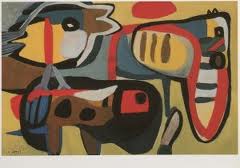
Karel Appel: ‘Mural of animals’, circa 1954 |
Art quotes of KAREL APPEL; the artist on painting & biography
- My paint is like a rocket, which describes its own space. I try to make the impossible possible. What is happening I cannot foresee, it is a surprise. Painting, like passion, is an emotion full of truth and rings a living sound, like the roar coming from the lion’s breast. To paint is to destroy what preceded. I never try to make a painting, but a chunk of life. It is a scream; it is a night; it is like a child; it is a tiger behind bars, c. 1953
* artist quote on painting as action-painting “Karel Appel, Painter”, Hugo Claus, Harry N. Abrams, New York, 1962; ; as quoted in Theories and Documents of Contemporary Art”, eds. Kristine Stiles & Peter Selz, University of California Press, 1996, p. 77
- It’s (painting, fh) like this – you are in front of your canvas, your hands holds the painting, ready, raised. The canvas waits, waits, empty and white – but all the time it knows what it wants. So – what does it want, anyway? My hand comes near, my eyes begin to transform the waiting canvas; and when – with my hand holding the paint and my eyes seeing the forms – I touch the canvas, it trembles, it comes to life. The struggle begins, to harmonize canvas, eye, hand forms. New apparitions stalk the earth, c. 1953
* art statement as a young artist in his Paris time: “Karel Appel, Painter”, Hugo Claus, Harry N. Abrams, New York, 1962; as quoted in Theories and Documents of Contemporary Art”, eds. Kristine Stiles & Peter Selz, University of California Press, 1996, p. 1998
- I don’t paint, I hit (around 1958, fh)
* statement on his early painting: movie “De werkelijkheid van Karel Appel”, Jan Vrijman; as quoted in “De Tweede Helft”, Ad de Visser, SUN Nijmegen, 1998
- The duty of the artist is not to be calculating in any sense, so that he may be free himself of human emotions while carried by the universal forces of life. Only then does one not think about making art, or about styles, or directions. Something comes about, something happens.
* statement on the task of an artist: “Karel Appel – the complete sculptures”, eds. Harry de Visser / Roland Hagenberg, Edition Lafayette, New York 1990
- Through play, we renew contact with childhood – My art is childlike.
* statement on his painting art: “Karel Appel – the complete sculptures”, eds. Harry de Visser / Roland Hagenberg, Edition Lafayette, New York 1990
- Knowledge isolates phenomena and things to observe with… …nothing is isolatable or can be removed from its environment. Anything which becomes isolated ceases to exist. It is like the violent refusal of someone to play a game in which everyone cheats.
* quote on the act of isolating things during creation: “Karel Appel – the complete sculptures”, eds. Harry de Visser / Roland Hagenberg, Edition Lafayette, New York 1990
- (artists are people) who employ matter between birth and death. Matter is something to use, not possess.
* quote on matter in creating art: “Karel Appel – the complete sculptures”, Edition Lafayette, New York 1990
- My brush-strokes start in nothing and they end in nothing, and in-between you find the image.
statement on the area of art creation: ‘The eye of the beholder…’, Carlo McCormick, “, eds. Harry de Visser / Roland Hagenberg, Edition Lafayette, New York 1990
- Every day I have to be awake to escape… …The whole world is sleepy. It is a real fight to be awake, to see everything new, for the first time in your life.
* statement on being an artist: ‘The eye of the beholder…’, Carlo McCormick in “Karel Appel – the complete sculptures”, eds. Harry de Visser / Roland Hagenberg, New York 1990
- The experience of the moment is what’s important, and somehow the image, the ‘thing’ is left over.
* art statement on creation: ‘The eye of the beholder…’, Carlo McCormick in ” Karel Appel – the complete sculptures”, eds. Harry de Visser / Roland Hagenberg, Edition Lafayette, New York 1990
- There exists an insanity that touches on a higher level, by knowledge or instinct. That insanity of life I try to put in my painting. It has nothing to do with any morals or laws. It is there and it is insane.
* quote on ‘insanity’ in his art: ‘The eye of the beholder…’, Carlo McCormick in “Karel Appel – the complete sculptures”, Edition Lafayette, New York 1990
- All the absurdity and hope are the stimulants to create. You make art to find a little hole to go on. You go through the whole to find the world again, and the absurdity is that still, somehow it is the same… …Hopelessness and hope are the same. It’s a very thin line you don’t see any more. I don’t believe in that line between hopelessness and hope today.
* Karel Appel, comment on hope ‘The eye of the beholder…’, Carlo McCormick in “Karel Appel – the complete sculptures”, eds. Harry de Visser / Roland Hagenberg, Edition Lafayette, New York 1990, p. 71
- The wastelands belong to my youth. When I was young I played in the outskirts of the city (Amsterdam, The Netherlands, fh), watching the cranes at the harbour. There was no law but garbage, grass and wildflowers like boys and girls, rough, hot and sexual and full of hidden pleasures. Life and death are overlapping in the wastelands like in my paintings. (1989)
* his artist quote on his youth in the Netherlands, Aamsterdam:, in “Karel Appel – the complete sculptures”, eds. Harry de Visser / Roland Hagenberg, Edition Lafayette, New York 1990, p. 75
- You can see the roughness of structure and the spots like wounds from battles on the canvas. The tops of skyscrapers with windows like eyes constantly remind you that there are laws surrounding the wastelands, and so you hide in the deep grass when you make love to a girl in dirty clothes, and experience how your nerves of seeing become stronger and stronger and every little sound more and more intense. That’s what Pasolini’s (Italian moviemaker, fh) poetry is partly about; he was a street guy and therefore I avoided beautiful new wood or metal for his sculpture… …The wasteland was Pasolini’s other side; the boys, the knives, the nights, the tensions (remark on making a sculpture of the Italian film director Pasolini, fh).
* his artists quote, referring to the movie-maker Pasolini ‘Quotes’, K. Appel (1989), in “Karel Appel – the complete sculptures”, Edition Lafayette, New York 1990, pp. 75-77
- One of my first sculptures was made of bicycle parts. I was living at that time in a attic in the red light section of Amsterdam. I started to work without any specific materials. I was looking in the street, like when I was a young boy, in the garbage cans, for ropes, wires, and paint. I left my parents in 1940. Years later I saw an exhibition of Kurt Schwitters at the Stedelijk Museum in Amsterdam curated by Willem Sandberg and there I saw the real objet trouvé; until then I had never heard about it. Schwitters was a shattering experience.
* his artist statement on ‘objet trouvé’ in modern art: (1989), in “Karel Appel – the complete sculptures”, eds. Harry de Visser / Roland Hagenberg, Edition Lafayette, New York 1990, p. 79
- I’m not a pessimist. Maybe I don’t have a primitive feeling of happiness, that is true. Sometimes my color is happy but not the expression.
* source: ‘Quotes’, K. Appel (1989), in “Karel Appel – the complete sculptures”, eds. Harry de Visser / Roland Hagenberg, Edition Lafayette, New York 1990, p. 85
-…our civilization is in a continuous state of self-repair. Maybe you have undergone surgery once. In former times you might have died. Today everybody can live on and on; everything around us is repaired, even the spirit. Look at the young artists. They only paint the façade and not the things hidden behind it. I don’t say that life is lost its originality. I show straightforwardly the state of repair of civilization. (statement on his sculpture ‘State of liberty’, fh)
* source: in “Karel Appel – the complete sculptures”, Lafayette, New York 1990, p. 85
- As an artist you have to fight and survive the wilderness to keep your creative freedom. Creativity is very fragile. It’s like a leaf in the fall; it hangs and when it drops you don’t know where it’s drifting.
* his statement on the tasks of being an artist: ‘Quotes’, K. Appel (1989), in “Karel Appel – the complete sculptures”, eds. Harry de Visser / Roland Hagenberg, Edition Lafayette, New York 1990, p. 91
- When I was young I once found a book in a Dutch translation, ‘The leaves of Grass’. It was the first time a book touched me by its feeling of freedom and open spaces, the way the poet spoke of the ocean by describing a drop of water in his hand. Walt Whitman was offering the world an open hand (now we call it democracy) and my ‘Monument for Walt Whitman’ became this open hand with mirrors, so you can see inside yourself.
* his artist quotes referring his experience, reading the poetry of Walt Whitman, in : ‘Quotes’, (1989), in “Karel Appel – the complete sculptures”, eds. Harry de Visser / Roland Hagenberg, Edition Lafayette, New York 1990, p. 93
- As I said, in the (19-) Fifties I had the angst (Dutch for ‘fear’, fh) to survive materialistically. In the city Paris it was a battle. I painted with a knife and called the results ‘human landscapes,’ abstract landscapes with human faces here and there. Today I can do without fight or struggle; every brushstroke now is ready, goes by itself: la peinture depouillé you could say. I discovered that in Picasso‘s late paintings. You look very closely but there is nothing anymore. He painted her and there a little bit; it is not finished, but once you step back you see a fantastic image, life by itself. I’m not fighting anymore; I’m floating, surfing on the wind.
* source of his artist quote on Picasso’s late paintings: ‘Quotes’ (1989), in “Karel Appel – the complete sculptures”, Edition Lafayette, New York 1990, p. 95
We hope you enjoyed
Karel Appel’s artist quotes
editor, Fons Heijnsbroek
translation, Anne Porcelijn
Karel Appel, his biography facts on life and creating art
Karel Appel was born in Amsterdam on in 1921; at fourteen he produced his first real painting on canvas, a still life of a fruit basket. Karel Appel studied at the Rijksakademie van Beeldende Kunsten in Amsterdam during the German Occupation from 1940 to 1943 and met there the young painter Corneille and, some years later, Constant; they became close friends for years. Appel had his first show in Groningen in 1946. In 1949 he participated with the other Cobra artists in the Stedelijk Museum Amsterdam; this generated a huge scandal and many objections in the national Dutch press and public. In 1947 he started sculpting with all kinds of used materials (in the technique of assemblage) and painted them in bright colors: white, red, yellow, blue and black. He joined the Experimentele Groep in Holland together with the young Dutch painters Anton Rooskens, Theo Wolvecamp and Jan Nieuwenhuys. Later the Belgian writer Hugo Claus joined the group.
In 1948 Appel joined CoBrA ( Copenhagen, Bruxelles, Amsterdam) together with the Dutch artists Corneille, Constant and Jan Nieuwenhuys (see also Aart Kemink) and with the Belgian poet Christian Dotremont. The new art of the Cobra-group was not popular in the Netherlands, but it found a warm and broad welcome in Denmark. By 1939, Danish artists as (Asger Jorn and Pederson) had already started to make spontaneous art and one of their sources of inspiration was Danish and Nordic mythology. It was also in Denmark that the Cobra artists started cooperating by collectively painting the insides of houses, which encouraged and intensified the exchange of the typical ‘childish’ and spontaneous picture language used by the CoBra group; Cobra proclaimed as their main goal to make spontaneous, direct and expressive modern art.
So did Karel Appel himself in his early artist-life, moving between modern expressionism in primitive, spontaneous figuration and almost abstract, gestural, energetic painting and sculpture. Later in life the humane figure became the most essential element of his art. After 1950 Karel Appel lived and worked in Paris, Italy and in New York, the time he became internationally famous. He made paintings as well as lithography and sculpture in all kind of materials. Late in his life Appel loved to combine painting and sculpture.
art links for more biography facts of the Dutch Cobra artist
* many images and pictures of Karel Appel’s colorful painting art, on Google
* many pictures of Karel Appel’s sculpture art, on Google
* Foundation Karel Appel; more information about life and creating art; Cobra
* * video of Karel Appel: life action of creating a painting
YOU ENJOY THE WEBSITE??